
What is Genesis 1 About?
Genesis 1-2:4a is probably the most controversial section of the Bible. Between Evolution and Old Earth debates, and much scholarship and division, the main debate is: is this section literal or metaphorical? In this section, I will explain how it is metaphorical, and how it affirms the greatness of God.
Night Sky

Figure 1: The Capture of Jerusalem
Other Religions' Myths
-
According to the Documentary Hypothesis, four sources, Jahwist, Elohist, Deuteronomist, and Priestly, along with a redactor, were used to write the Pentateuch, or Torah, which are the first 5 books of the Bible.
-
Genesis 1-2:4a is from the Priestly source [1], and was likely written during or after the Babylonian Captivity [2], where Babylon, under King Nebuchadnezzar, sieged and took Jerusalem, destroyed the Jews’ temple, and deported much of the population away from the Holy Land.
-
This came after much conflict with other peoples, including the Egyptians and Assyrians. The Jews, being constantly surrounded by people of different religions, naturally heard about their theologies, and thus wanted to show how their God, YHWH, was better than the pagan gods.
-
The tactic of the Hebrew writers was to use the key words and ideas of these Pagan myths, but use it in a way that showed YHWH as the true and righteous God.
-
Thus, the creation account of Genesis 1-2:4a accomplished this.
-
Most of the data on this page is from the third citation from this page. [3]
Primeval Ocean Analogy
-
The Hebrew word, tehôm, is a deep, primeval ocean in Genesis 1:2. It is from a common semitic root used in the Akkadian, Ugaritic, and Arabic languages, which other religions used as a cosmological battle myth.
-
For example, in Babylonian Creation myths, there originally was nothing except personified entities: Apsu and Tiāmat, the primeval sweet and salt waters.
-
They believed that their gods then evolved through these waters, and had cosmological battles, where Apsu lost to Ea, then Tiāmat reigned, until, finally, Marduk, one of the new gods, defeated Tiāmat, and won.
-
Genesis 1:2, in contrast, has the tehǒm waters as a mere creature of God, with no conflict ensuing. There is no personification of this water, just a demystified creature briefly mentioned.
-
Non-mythical overtones of this word are also present in Psalm 33:7, 104:6, and Job 38:16.
-
Thus, Genesis says that there is only one God, the God of the Torah, and that this God is peaceful, relative to the other gods people nearby worshipped.

Figure 2: Inscription of King Nebuchadnezzar

Figure 3: Anath. Goddess of War and Hunting
Creatures Analogy
-
The Hebrew word for creature, used in Genesis 1:20-21, is tannin.
-
A related Ugaritic word, tnn, is used in the pagan Baal-Anath cycle, where Anath, Baal’s sister, talks about muzzling of a dragon, called tnn.
-
In the same story, Anath also boasts about overcoming other gods, such as Nahar, Yam, and Lotan.
-
These verses clearly glorify victory of their gods through conflict.
-
Similar to Tiāmat, the Hebrew version of the word, tannin, is used non-mythically throughout the Bible as a generic term, opposed to a proper noun.
-
In Psalm 148:6, they, along with other elements of God's creation. are even called to praise YHWH.
-
In Genesis 1:21, the tannin, or sea creatures, are created, the first time the word for created, bārā, is used since Genesis 1:1.
-
This emphasizes that tannin is a mere creature, created by God, not to be worshipped. In fact, many things God creates in Genesis were worshipped by other peoples at that time.
-
In this way, Genesis’ message affirms again that there is only one God, YHWH, to be worshipped.
Separation of Heaven and Earth
-
In Genesis 1:6-8, there is a separation of Heaven and Earth, common in Ancient Near East cosmology.
-
Enuma elish, a Babylonian epic, says the champion god, Marduk, who previously defeated other gods, separated them via the body of the slain enemy.
-
in the Hittite version of this, a cutting tool is used to split the Heavens and the Earth.
-
Phoenicians said that the separation the splitting of the world egg.
-
In Egyptian mythology, Nut, the sky goddess, was pushed up by Geb, the Earth god, creating the separation.
-
In Genesis 1:6 of the Bible, a separation is noted, but, in contrast to the myths preceding it, it is done effortlessly by God, and without combat, as the waters are powerless.
-
The writer of this source of the Bible clearly showed how God is all powerful and inherently peaceful, making Him, in comparison, better than the other pagan gods in contact with the Jews.

Figure 4: Modern Depiction of Ancient Near Eastern Cosmology
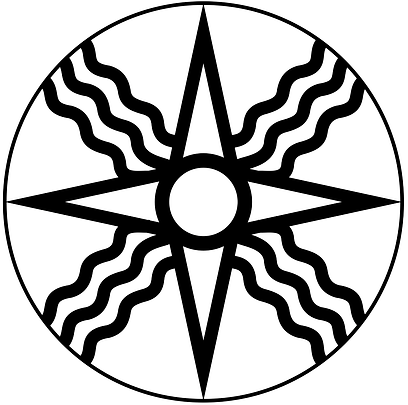
Figure 5: Star of Shamash (Utu)
Sun and Moon Worship
-
In addition, to the cosmic conflict, there was also worship of the sun and moon in Sumerian, Egyptian, Hittite, and Akkadian, religions at this time period.
-
The Babylonians in Enuma elish, even imply they are uncreated, further deifying them.
-
In contrast, Genesis 1:14-18 shows that they are created.
-
The Hebrew writer doesn’t even mention the sun and moon by name, as this would have implied worship at that time, since the names for Sun and Moon were also names of Pagan gods.
-
As usual, Genesis also gives no divine quality to these two celestial objects, leaving YHWH as, still, the only one to be worshipped.
The Purpose of Man
-
The final piece to the puzzle is in Genesis 1:26-28, where God creates people in His image.
-
Sumerian-Akkadian mythology show that man is created to relieve the gods from their labor.
-
People’s creation is merely an afterthought of the gods, diminishing our importance to them.
-
In Genesis, though, it is a clear contrast. People are the pinnacle of God’s creation, and are blessed by Him (Genesis 1:28), and given all seed-bearing plants and fruits (Genesis 1:29).
-
Differing from the Pagan myths, Genesis is a person-centered account, giving humanity more freedom than any pagan account does.
-
This person-centric model of Genesis is fulfilled in Jesus Christ (יֵשׁוּעַ), who voluntarily humbled Himself and became a common man for the sake of our salvation (Philippians 2:5-11), something that the pagan gods would likely not do. [3]

Figure 6: Tablet of Epic of Gilgamesh

Figure 7: Temple of Esna (Egypt)
Why 7-days?
-
In the Ancient Near East, pagan temples were dedicated in 7-day ceremonies, with the god of the temple coming to rest inside once it was complete.
-
In Genesis, God, “rested,” on the 7th day (Genesis 2:2), not because He needed it, as He is all powerful, but to show that the Cosmos is His temple, and God is here with us, as seen in Exodus 40:34 and Mark 2:5-10.
-
This, similar to the rest of the creation account, it is metaphorical, and used as a better alternative to the other religions at that time and place.
-
In addition, it is also a way of God relating to us, by making His creation similar to a traditional workweek (Exodus 20:11). [4]
Conclusion
-
At the time Genesis 1-2:4a (part of the Priestly Source) was written, the Jews were either in, or had just experienced Babylonian Captivity.
-
Jerusalem was taken, the temple destroyed, their people deported, and being surrounded by people with religions other than theirs.
-
The author(s) of this source compared YHWH, the God of the Bible, with the pagan gods, showing how peaceful and effortless He is in comparison, showing that only He is to be worshipped, that He has no rival, and showing the immense value of humanity.
-
For these reasons, Genesis is a symbolic account, not designed to be plain history or scientific information, and, thus, the idea of an Earth older than ten thousand years, and Evolution itself, is fully consistent with Genesis.
-
For more information on how a symbolic Genesis is compatible with Christianity, click here.


Figure 8,9: Destruction of Jerusalem and Hanging Gardens of Babylon
Common Objections
Does this mean that God endorsed these Pagan beliefs?: Dr. Abner Chou, an expert in Biblical Languages and Head Translator for the Legacy Standard Bible [5], argues in an article [6] that my hypothesis is incorrect, because that would mean God is embracing the ideas of Paganism, which would contradict His nature. I respond that God is saying that Pagan religions exist, which is true, and that what they worshipped, whether it be the primeval oceans, the sun and moon, etc... is not God. He is not endorsing their views, but correcting them.
Different literary styles between Pagan and Hebrew sources: Dr. Chou then argues that, since the creation story in Genesis has a vastly different style to that of the Ancient Near Eastern myths, it could not be a copy of them. I respond that the Hebrews had a different culture than the people surrounding them, and, thus, it would make sense that their literary styles would be different. Also, since there were likely many myths from many different cultures at that time, writing everything exactly the same would make Genesis an unnecessarily ling book. Genesis 1-2:4a is a summary of many ideas and myths in only a few sentences. Thus, it makes sense that it follows its own poetic rules.

Figure 10: Babylonian Empire under King Nebuchadnezzar
Bibliography for This page
[1] projects, Contributors to Wikimedia. “Bible/King James/Documentary Hypothesis.” Wikiversity, Wikimedia Foundation, Inc., 4 Dec. 2024, en.wikiversity.org/wiki/Bible/King_James/Documentary_Hypothesis.
[2] Brettler, Marc Z. “Introduction to the Pentateuch.” New Oxford Annotated Bible New Revised Standard Version With the Apocrypha, 5th ed., Oxford University Press, Oxford, New York, 2018, pp. 3–6.
[3] Hasel, Gerhard F. “The polemic nature of the Genesis cosmology.” Evangelical Quarterly: An International Review of Bible and Theology, vol. 46, no. 2, 6 Oct. 1974, pp. 81–102, https://doi.org/10.1163/27725472-04602004.
[4] “How Long Are the Days of Genesis 1? - Common Question.” BioLogos, 16 Jan. 2019, biologos.org/common-questions/how-long-are-the-days-of-genesis-1.
[5] “Abner Chou.” The Master’s University, 26 Aug. 2025, www.masters.edu/leadership_bio/abner-chou/.
[6] Chou, Abner. “Genesis-the Original Myth Buster.” Answers in Genesis, Answers In Genesis, 10 Jan. 2021, answersingenesis.org/creationism/creation-myths/genesis-the-original-myth-buster/.